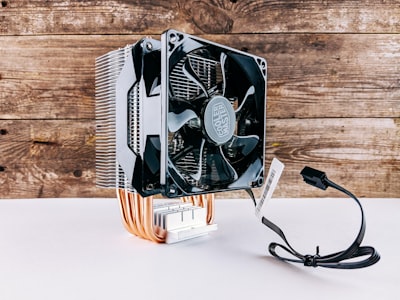
Cooling high-performance components is not just about dissipating heat: it is an engineering challenge that combines thermodynamics, mechanical design, and material optimization. In this context, the launch of the Cooler Master V4 and V8 3DHP heatsinks represents a milestone in CPU thermal management, showcasing how innovation in three-dimensional heat pipe structures can make a difference in demanding computing environments, from workstations to artificial intelligence servers.
The true achievement of these models lies in the integration of multiple heat pipes that traverse the heatsink in various directions, increasing the contact surface area and thermal transfer speed. This approach, called 3D Heat Pipe (3DHP), allows reaching power densities that previously required liquid cooling systems or large tower radiators. To understand its impact, it is worth remembering that the performance of any computer system critically depends on keeping temperatures within safe operating ranges; a failure here can degrade hardware or reduce the lifespan of components.
From a business perspective, companies that develop custom software for thermal simulation or cooling system design could benefit from this type of innovation. For example, modeling the behavior of heat pipes in non-linear configurations requires advanced calculation tools and optimization algorithms. At Q2BSTUDIO, we are specialists in creating custom applications that solve complex engineering problems, integrating artificial intelligence to predict heat flows or detect critical points before manufacturing a prototype.
Furthermore, efficient cooling management is not only relevant for PC enthusiasts but also for data centers seeking to reduce their carbon footprint and operational costs. There, AWS and Azure cloud services can host digital twins of these systems, enabling massive simulations without the need for local infrastructure. Combined with business intelligence services based on Power BI, operators can monitor the temperatures of entire racks in real time and make predictive decisions.
Another key front is cybersecurity. By implementing IoT sensors in cooling systems, potential attack vectors are opened. Therefore, having cybersecurity and pentesting services is vital to secure the infrastructure. Companies that integrate AI for business can also use AI agents to automate fan curve adjustments or alert on thermal anomalies, all from scalable platforms.
In summary, Cooler Master's feat with the V4 and V8 3DHP transcends mere hardware: it is an example of how multidisciplinary engineering – supported by advanced digital tools – can offer more efficient solutions. At Q2BSTUDIO, we help organizations adopt these capabilities through custom software developments, applied artificial intelligence, and robust cloud architectures, so that their cooling, automation, or thermal analysis projects achieve the same level of excellence.